


Forming an Indiana corporation starts with a state filing, but the decisions you make before submitting it can affect how the company operates long after approval. You need to choose an available corporate name, appoint an Indiana registered agent, decide how the corporation’s shares will be structured, and file articles of incorporation with the Indiana Secretary of State through INBiz.
This guide walks through the process for a domestic for-profit corporation. It also covers the internal documents, tax registrations, and recurring filings you may need after the corporation is formed.
Key takeaways
- Indiana corporations are formed by filing articles of incorporation with the Secretary of State through INBiz.
- Before filing, choose an available corporate name, appoint a registered agent with an Indiana street address, and decide how many shares the corporation will authorize.
- After approval, obtain an EIN, adopt bylaws, appoint officers, hold an organizational meeting, issue stock, and open a corporate bank account.
- Indiana corporations must file a business entity report every other year. For-profit businesses currently pay $32 through INBiz or $50 on paper.

Why form a corporation in Indiana?
A corporation can own property, enter contracts, and shield its members from certain liabilities. Shareholders generally receive liability protection from the corporation’s obligations as long as the company is properly formed and operated.
A corporation may make sense if you want to issue stock, bring in outside investors, establish a formal board structure, or create an ownership model that can continue when shareholders change. Corporations also have more governance requirements than most limited liability companies. They typically need bylaws, directors, officers, stock records, meeting minutes, and other internal records.
How to form an Indiana corporation in 8 steps
The state filing is only one part of incorporation. Complete the following steps to create the corporation and prepare it to operate.
Step 1: Choose a name for your Indiana corporation
Your corporation’s name must be distinguishable from the names of other businesses on file with the Indiana Secretary of State. The name also needs an accepted corporate designator, such as “Corporation,” “Incorporated,” “Company,” “Limited,” or an abbreviation of one of those terms.
Start with the Indiana business search on INBiz. The search is preliminary, so a name that appears available is not guaranteed until the Secretary of State reviews your filing. Search close variations, alternative spellings, and abbreviations before committing to a name.
Free Indiana Business Name Check
Starting a business? Use our free name check tool to check your business name against existing records in Indiana.
By clicking "Check Availability," I agree to LegalZoom's Terms of Use. This search is a preliminary check of state databases and does not include variations or trademarks. Results do not guarantee name availability or compliance with legal requirements.
Indiana lets you reserve an available name for 120 days if you are not ready to incorporate. A reservation is optional. You can also move directly to the articles of incorporation if you are ready to file.
Note: State name availability does not create trademark rights. Search the USPTO trademark database and consider whether the name could conflict with another company’s brand. For more naming best practices, refer to our comprehensive guide to Indiana business names.
Step 2: Appoint an Indiana registered agent
Every Indiana corporation must continuously maintain one registered agent and one registered office in the state. The registered agent receives service of process, tax notices, and other official documents for the corporation.
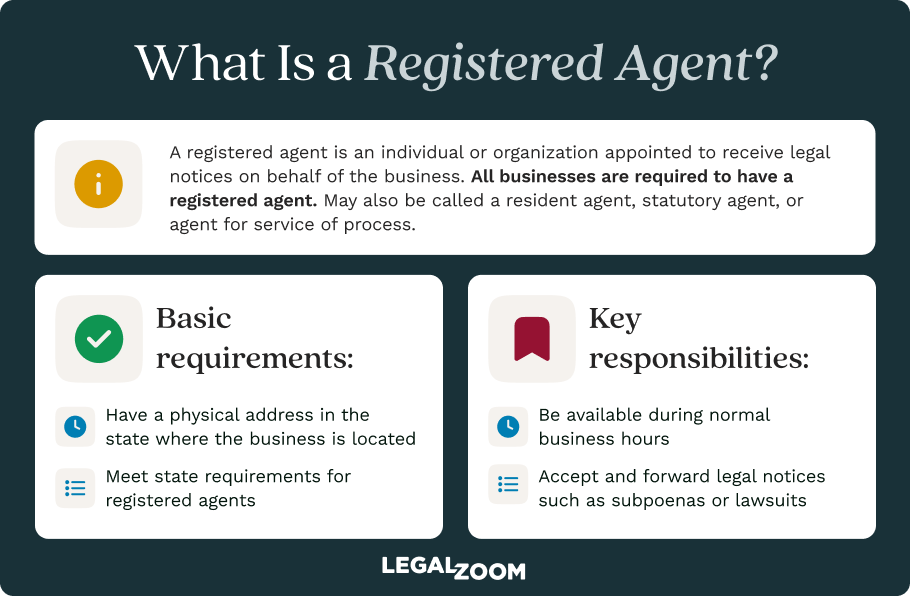
The agent may be an Indiana resident or an eligible business entity with a physical presence at the registered office address. The registered office must be a physical Indiana street address where documents can be delivered. A P.O. box alone is not sufficient. Indiana also states that a business cannot serve as its own registered agent, although an eligible owner, director, officer, or other individual may serve in that role.
Choose someone who can reliably receive documents during normal business hours. Missing a lawsuit, tax notice, or state filing notice can have serious consequences. A commercial registered agent service can also keep an owner’s home address off the public registered office registry and provide coverage when no one is consistently available at the business location.
Step 3: Decide how many shares the corporation will authorize
A corporation is owned through stock, so the articles of incorporation must describe the shares the company is authorized to issue. Authorized shares are the maximum number of shares the corporation can issue under its current articles. Issued shares are the shares the corporation has actually transferred to shareholders.
The corporation does not have to issue every authorized share at formation. For example, a corporation may authorize 10,000 shares but initially issue only 6,000 to its founders. The remaining shares could be held for future employees, investors, or other transactions, subject to the board’s approval and the corporation’s governing documents.
Think through the following questions before filing:
- How many founders will receive stock?
- Will the corporation need shares for future investors or employees?
- Will all shares have the same voting and economic rights?
- Does the corporation need more than one class or series of stock?
A simple closely held corporation may use one class of common stock. A company planning to raise institutional capital, issue preferred stock, or negotiate different investor rights should get legal advice before filing. Changing the authorized share structure later may require an amendment to the articles of incorporation.
Step 4: Choose the incorporator and initial directors
The incorporator is the person who signs and submits the articles of incorporation. The incorporator does not have to be a shareholder, director, or officer. The role may be temporary and can end after the corporation is formed and the initial directors are appointed.
Decide who will serve as the initial director(s) before filing or prepare an incorporator action that appoints them immediately after the state accepts the articles.
Step 5: File Indiana articles of incorporation through INBiz
The articles of incorporation legally create the corporation. Indiana uses State Form 4159 for a domestic for-profit corporation, and the Secretary of State encourages businesses to file online through the INBiz portal.
Before starting the process, gather the following information:
- The corporation’s exact legal name
- An email address for the business (for processing updates)
- The principal office address
- The registered agent’s name and Indiana street address
- The number and class of authorized shares
- Name, address, and signature of the incorporator(s)
- Any additional provisions the corporation needs in its articles
- Credentials and license numbers (for professional corporations only)
Remember: The principal office and registered office may not be the same. The principal office is the corporation’s main business or records address, whereas the registered office is the Indiana address where the registered agent receives official documents.
INBiz calculates the filing charge before payment. The paper version of the articles of incorporation lists the state filing fee for a domestic for-profit corporation, while an online submission may include an electronic processing charge. Check the current fee in the INBiz fee calculator or on State Form 4159 immediately before submitting the filing.
You can also submit the paper form to the Indiana Secretary of State, Business Services Division, at the address shown on the form. Online filing generally offers lower fees, faster processing, status tracking, and checks that can reduce filing errors.
Step 6: Get an EIN and register for Indiana taxes
A corporation generally needs a federal employer identification number (EIN), even if it does not have employees. The EIN identifies the corporation for federal tax purposes and is commonly required to open a bank account, run payroll, and apply for licenses.
Apply directly with the IRS after the Secretary of State accepts your articles. The IRS does not charge a fee to get an EIN.
Next, determine which Indiana tax accounts apply. The Indiana Department of Revenue uses the INTIME portal for business tax registration and account management. A corporation may need to register for sales tax, employee withholding, food and beverage tax, or other tax types based on its activities. Indiana charges a one-time $25 registration fee for each retail-merchant location.
A business with employees may also have reporting and insurance responsibilities through the Indiana Department of Workforce Development. INBiz connects businesses to both the Department of Revenue and the Department of Workforce Development, but each agency administers its own requirements.
Step 7: Adopt bylaws and hold the organizational meeting
Corporate bylaws are the corporation’s internal operating rules. Indiana Code § 23-1-21-6 requires for-profit corporations to adopt bylaws. They are not filed with the Indiana Secretary of State, but they help establish how the corporation will make decisions and maintain its records.
Corporate bylaws commonly address:
- The size and authority of the board of directors
- How directors and officers are elected or removed
- How meetings are called and conducted
- Notice, voting, and quorum requirements
- The duties of corporate officers
- How shares may be issued or transferred
- How conflicts of interest are handled
- How the bylaws may be amended
After the initial directors are appointed, they should hold an organizational meeting or approve written organizational actions. The directors typically adopt the bylaws, appoint officers, authorize the issuance of stock, approve a bank account, set the corporation’s fiscal year, and approve initial contracts or expenses.
Document each decision in meeting minutes or written consents. Keep those records with the articles, bylaws, stock ledger, resolutions, tax documents, and other corporate records. Annual meeting minutes are internal records and are not submitted to the Secretary of State.
Note: Indiana Code § 23-1-52-1 requires corporations to keep meeting minutes and records of all actions taken by shareholders or directors outside of meetings. These must be retained internally.
Step 8: Issue stock and open a corporate bank account
Your articles authorize the corporation to issue shares, but ownership isn’t formally established until the corporation actually issues stock to shareholders. The board should approve each issuance and document what the shareholder provides in exchange, such as cash, property, or services when legally permitted.
Maintain a stock ledger showing each shareholder’s name, the number and class of shares issued, the date of issuance, and any later transfers or cancellations. The corporation may use paper stock certificates or uncertificated shares, depending on its governing documents and applicable law. Either way, the ownership records need to be clear and current.
Open a bank account in the corporation’s legal name and keep business money separate from personal funds. A bank may request the file-stamped articles of incorporation, EIN confirmation, bylaws, a board resolution authorizing the account, and identification for the people who will sign on it. Requirements vary by financial institution.
Keeping finances and records separate helps the corporation operate as an independent legal entity. It also supports accurate accounting and reduces the risk that owners will be treated as if the corporation were only an extension of their personal affairs.
Indiana corporation costs
The cost of creating and operating an Indiana corporation depends on what services and administrative options you utilize. Common expenses include the following.
- Articles of incorporation filing charge: Varies. Confirm your amount through the INBiz fee calculator or State Form 4159 before filing.
- Name reservation: Optional if you want to hold a name before incorporating.
- Registered agent service: $50–$300. Optional if an eligible person or business will not serve as the agent.
- Business entity report: Every other year; $32 through INBiz or $50 on paper for a for-profit business, filed every other year.
- Retail merchant certificate: A one-time $25 registration fee for each location that must register as a retail merchant.
- Local and professional licenses: Costs depend on the corporation’s industry and location.
- Legal, tax, and formation help: Optional for a routine filing, but wise for complex ownership, financing, tax, or regulatory issues.
Indiana corporation compliance requirements
Formation is not the end of the corporation’s state responsibilities. A corporation must keep its state record current, maintain its internal records, file tax returns, and renew the licenses or permits that apply to its work.
File the Indiana business entity report
Indiana corporations file a business entity report every other year. The first report is due two years after the corporation is formed. Reports are due during the anniversary month of formation, and the business has until the end of that month before the report is considered past due.
The report updates or confirms the corporation’s principal-office address, registered agent information, business email address, and at least one officer or other governing individual. For-profit businesses currently pay $32 through INBiz or $50 on paper.
Note: Failure to remain compliant can lead to administrative dissolution. INBiz sends notices, but the corporation should maintain its own compliance calendar rather than relying only on state reminders.
Maintain a registered agent and current addresses
The corporation must continuously maintain a registered agent and registered office in Indiana. File the appropriate update through INBiz when the agent, registered office, principal office, business email, or governing-person information changes.
Keep corporate records and follow the bylaws
Hold the meetings required by the bylaws, document major decisions, and maintain accurate stock and financial records. Corporate formalities are particularly important when several shareholders are involved or the corporation is seeking financing.
File state and federal tax returns
Register for the tax accounts that apply and file each required return on time. The corporation may have obligations involving corporate income tax, sales tax, employee withholding, unemployment insurance, and local taxes. Tax treatment can change when the corporation makes a federal election or begins new activities.
Obtain state and local licenses
Indiana does not issue one general statewide business license that covers every corporation. Licensing depends on the industry, occupation, products or services, and business location. Regulated professions may need approval from the Indiana Professional Licensing Agency or another board. Cities and counties may require zoning approval, building permits, health permits, or other local filings.
Qualify in other states (when required)
An Indiana corporation that regularly conducts business in another state may need to register there as a foreign corporation. The rules vary by state and activity, so review the requirements before opening an office, hiring employees, or establishing substantial operations outside Indiana.
Indiana corporation vs. LLC
Corporations and limited liability companies both provide a legal structure that is separate from their owners, but they operate differently.
A corporation has shareholders, directors, officers, bylaws, and stock. Its formal ownership structure can be useful when a business plans to bring in investors, transfer shares, offer equity compensation, or pursue institutional financing.
An LLC has members rather than shareholders and usually operates under an operating agreement. It can offer more flexibility in management and fewer formal governance procedures. An LLC is also generally taxed as a pass-through entity by default, while a corporation is generally taxed as a C corporation unless it qualifies for and makes another election.
An S corporation is a federal tax classification, not a separate Indiana business entity. An eligible Indiana corporation or LLC may elect S corporation tax treatment by filing the appropriate form with the IRS.
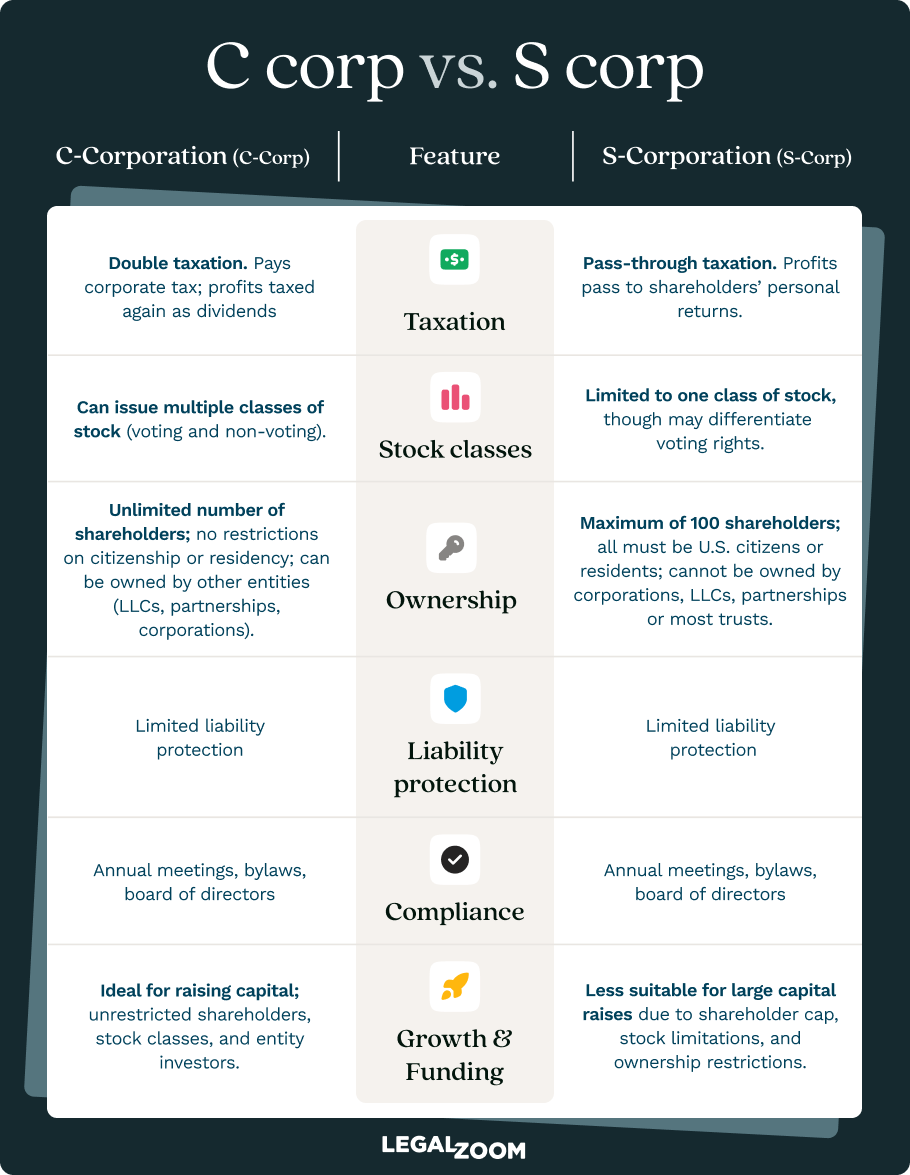
A corporation may be the stronger fit if you expect to issue multiple equity interests or seek outside investment. You may want to form an LLC if you want simpler governance and more flexibility. Consider seeking legal and tax advice before choosing between them.
How to form your Indiana corporation with LegalZoom
You can complete the Indiana filing process yourself through INBiz. However, handling the process on your own could increase your risk of errors that keep you from being able to open your doors. LegalZoom’s corporation formation services can take the stress out of the process.
LegalZoom can help prepare and submit the articles of incorporation. We can also help you keep up with compliance, registered agent requirements, bylaws, and business license management.
For advice on a complex share structure, investor financing, professional corporation, regulated business, or specialized tax election, consider consulting one of our network of attorneys in Indiana.
Indiana corporation FAQs
How long does it take to form an Indiana corporation?
Processing time depends on the filing method, volume, and whether the submission contains errors. Online filings are generally processed more quickly than paper filings. INBiz lets account holders track the status of an online transaction, and the Secretary of State sends notice when a filing is approved or rejected.
What information is required in Indiana articles of incorporation?
Be prepared to provide the corporation’s legal name, principal office address, registered agent and Indiana registered office address, authorized share information, incorporator details, and any additional provisions the corporation needs.
Can one person form and operate an Indiana corporation?
A single person can generally serve as the corporation’s sole shareholder, director, and officer. The person may also act as incorporator. The corporation still needs a registered agent, separate finances, appropriate records, and documented corporate decisions.
What is the difference between a C corporation and an S corporation in Indiana?
A C corporation is the default federal tax treatment for a corporation. An S corporation is an election available to eligible corporations that meet federal requirements. Both remain corporations under Indiana law and follow the same Secretary of State formation process. The difference primarily concerns tax treatment and federal eligibility restrictions.
What happens if Indiana rejects the articles of incorporation?
The Secretary of State will notify the filer that the submission was rejected and identify the issue that needs correction. The corporation is not formed until the articles are accepted. Review the notice, correct the filing, and resubmit it through the method directed by INBiz or the Business Services Division.
'%20/%3e%3c/svg%3e)

'%3e%3cpath%20fill-rule='evenodd'%20clip-rule='evenodd'%20d='M9.31239%2025.5316H13.0679V14.1032H9.31239V25.5316ZM11.1913%208.46875C9.93945%208.46875%209%209.25086%209%2010.505C9%2011.5995%209.78211%2012.5389%2011.1913%2012.5389C12.6005%2012.5389%2013.3826%2011.5995%2013.3826%2010.505C13.3826%209.4082%2012.6005%208.46875%2011.1913%208.46875ZM27%2018.9577V25.5316H23.2445V19.4275C23.2445%2017.8609%2022.6174%2016.7664%2021.3679%2016.7664C20.2711%2016.7664%2019.644%2017.5463%2019.3316%2018.1756C19.1743%2018.488%2019.1743%2018.8004%2019.1743%2019.1128V25.5316H15.4165V13.9458H19.1743V15.5123C19.644%2014.7302%2020.5835%2013.6357%2022.6174%2013.6357C25.1234%2013.7908%2027%2015.3573%2027%2018.9577Z'%20fill='white'/%3e%3c/g%3e%3cdefs%3e%3cclipPath%20id='clip0_952_9489'%3e%3crect%20width='18'%20height='18'%20fill='white'%20transform='translate(9%208)'/%3e%3c/clipPath%3e%3c/defs%3e%3c/svg%3e)